Heat pipes are fundamental in regulating the temperature of water by utilizing the heating and transferring of a working fluid within a vacuum sealed glass and copper tube.
What are heat pipes used for?
Heat pipes can be used for many different functions throughout common items in our society. Most commonly, heat pipes can be found within computers to help with cooling the device. Any system where heat needs to be transferred, is likely to use a heat pipe. Along with cooling computer processors, heat pipes can be used for isothermal furnace liners and aerospace heat transfer.
How do heat pipes work?
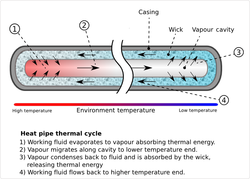
Heat pipes have three main components, the outer shell, the working fluid, and the wick. The outer shell contains the working fluid and the wick. As the pipe is heated the working fluid evaporates and transfers the heat through the system. When the vapor reaches the non heated end of the pipe in condensed an transfers the heat to the shell. Once condensed the wick structure allows the condensed fluid to travel back to the heated end of the pipe.
What materials are used in heat pipes?
Heat pipes can be created from a variety of materials which depend on the function of the heat pipe. They can be made from copper, steel, aluminum, and super alloys. They can also be created with a variety of working fluids including, water, refrigerant, and ammonia.
References:
[1]J. Hruska, "New Fujitsu heat pipe technology could cool your next smartphone | ExtremeTech", ExtremeTech, 2016. [Online]. Available: http://www.extremetech.com/extreme/201197-new-fujitsu-heat-pipe-could-cool-your-next-smartphone. [Accessed: 07- Apr- 2016].

No comments:
Post a Comment